
Paula Burger's Video Library
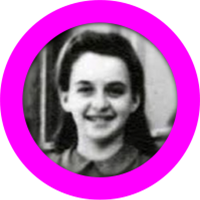
Paula Burger
Transcript
Paula Burger: He [Paula’s father] – I guess you would call it sort of like commodities, I remember the stories he would tell us, about going and buying like a forest for its trees, or for the wood, or buying futures in an apple orchard, and he would bring back apples in the winter, because we – at the time, in my home, there was no refrigeration – so he would bring apples and freeze them in the winter, and tell us that these came from this orchard and this from that orchard, and telling us different stories about the trees, they would chop down one tree to find out the type of wood, and then basically they would buy it on the knowledge of futures – what kind of wood it would be or what kind of apple crop it would be. Later, I remember he had a store that had food products in it, and I remember – that must have been closer to the war already – because I remember them bringing a lot of candy.
Chapter 1: Paula's life before the war
Transcript
Paula Burger: Well for us, the war broke out somewhere when the Nazis invaded Poland, in ’39. But for us, it didn’t come to us until later, and we would have, I would hear my parents talk about people that they would call refugees. The people they would refer to as refugees were people who came from Poland like Warsaw, Lodz, or somewhere from the big cities of Poland because the war didn’t get—we were further into the interior, towards Russia. It’s probably, maybe not unlike Denver to people from New York, or Chicago, or LA. The town I lived [in] probably was the size of like Colorado Springs, it was—it had a university and a lot of yeshivas, and um, I think the poet laureate of Poland came from there, so it was kind of—but it wasn’t like a big city, so for us it came slower and people had come—run away from the larger cities.
Chapter 2: War on the horizon
Transcript
Paula Burger: The first time I remember, really, the feeling of the fear. Which unfortunately never goes away, all the way. Some of the residue stays with you. And although you know how old I am now, it’s been a long time, and still, without too much effort at all, I can recall the feelings of that. And it’s knowing that my father had to go to work – I guess the Germans were coming in and everyone was supposed to put in certain hours of work to help with whatever. And then I remember a Friday night with the candles being lit and my father was coming home late, and you know, as a child you don’t really know the details but you know when your mother is scared, or when your mother is upset, and I remember her holding me in her arms, just like you would hold a baby. And though at that time I was 4 ½, closer to 5 [sic], but I wasn’t very big, and the feeling of that security I had felt for many, many years, and in all the years after that I had tried to recall that feeling of feeling safe, and it helped at times. So. That was my first knowing of the war and that we were supposed to go into the ghetto. Though it didn’t make any sense to me, I knew we were supposed to go in the ghetto. And then the bombs would start flying. The airplanes would start flying, and we could see the planes because in those years they weren’t flying that high, and they would actually bomb the city, and then we would hear – where we lived, it was a little bit outside the city, I guess, so we weren’t bombed but we could hear the planes and the whistle of the low-flying planes, and people coming, sort of like running away from the bigger centers to hide out, and the fear of that told me how bad we were doing, but my parents didn’t share with me the details, because I was so young. And then within a short time later, we went to the ghetto. We packed up, taking very little.
Chapter 3: "The sky exploded": Germans occupy Novogrudek
Transcript
Paula Burger: My father, having grown up in the area and being [in] business and having a lot of friends and obviously, to our luck, you know, some of his friends were not Jewish that helped him. And we would sneak into the ghetto at night. The ghetto was patrolled by German soldiers with guns, walking around. But somehow we would find a place, and I remember going into the ghetto one time, where my father would jump over the fence, and then my mother would hand us over the fence, and then somehow she would get over the fence, and we did this a couple times. Or we wouldn’t have survived, even at that point.
Chapter 4: “Black Monday” in Novogrudek, part 1
Transcript
Paula Burger: And so, one time when we went out of the ghetto, my mother and my brother and I were walking toward the house of these people that their daughters would stay with us for a year or so and take care of us kids, and we were walking towards their house, and it must have—in the winter, and my father wasn’t with us. And I remember my mother, she was carrying my brother, and me too, part of the time, and telling me—I couldn’t walk anymore, because I was tired and cold, and I remember the whistling of bullets, so there must have been shooting, or whatever. We must have been running away from somewhere. And she would tell me to keep me going that my father was over there. And that always made me walk a little bit longer. And we stayed with these people for about 3-4 days, and then they made us leave because they were in great danger if anybody found anybody hiding Jewish people, they would be shot immediately. Their children, even the pets they would shoot, and then burn the house down. And so, the people that helped – that were as they’re called today the righteous gentiles, they really were, because it’s really hard to imagine when your life, and your children’s lives and all your relatives’ lives are in danger, you’re really hesitant to do anything. So. And then we would end up in the ghetto again, because we couldn’t survive outside the ghetto.
Chapter 4: “Black Monday” in Novogrudek, part 2
Transcript
Paula Burger: And as the time went on, my father ran away from the ghetto because he was trying to figure out a way to get us out of there, and the people that – as the Jews, the Jewish people moved out of their estates or their houses, and the Polish neighbors took them over, and some of them were adamantly opposed to us ever coming back. And some took action, and some didn’t. The people that moved in on our property took action by going to the SS and telling them that we were subversives, or who knows what. I mean, they would kill Jews on sight, anyway, so I don’t know what. But anyway, he [the neighbor] tried to make sure that we didn’t survive. And my father knew about that, because from other neighbors, so anyway he ran away from the ghetto, and they came looking for him in the ghetto, and he was gone so they interrogated my mother, and they asked her if she had children and she said no, knowing that they would shoot us on sight, no matter what. So, they arrested her and kept her in prison for about, probably for a couple of months. And my aunt took us in and kept us. […]
And I guess when they arrested my mother, she motioned to my aunt to take us away, because we were outside. And she took us in the house, and she kept us. […]
So anyway, my mother, having been to the university, the German was a very favored language of the universities, my mother spoke fluent German, so she was an interpreter, and they kept her in prison for a couple of months, and then they shot her in a mass grave with other people. I didn’t know it at the time, it’s now 54 years later and I have goosebumps when I tell you about this, though I’ve known people to tell me how calm I look, but it doesn’t feel that way inside.
Chapter 5: Novogrudek ghetto: murder and escape, part 1
Transcript
Paula Burger: My father, knowing the situation we were in, somehow devised a plan to get us out of the ghetto. They used to bring water into the ghetto in those large wooden barrels like maybe now you see—used to see pickles, or something really— those big barrels. At least that was one of the means to bring water in. Somehow, he got the person who brought the water in to sneak us out of the ghetto by putting me and my brother in a barrel and driving us out of the ghetto. I remember my aunt telling us that we were going—to take care of my brother, that this was how we were going to go, in a barrel, and we have to be very quiet, and that if—I knew that the Germans would shoot us if they found us. And they put us in this barrel, and the fear. It takes nothing at all for me to get that fear back, even as I speak to you. Of sitting in this damp barrel, holding on to my brother for dear life, and hoping that he would be quiet, because he was so little, he could cry, and we had to go through guards. And it was lucky that they didn’t look in the barrel, I’m sure they must have looked sometimes. And just to keep him quiet—the fear. Um, I have no idea—logically—how I did it. But, like I said, maybe just remembering how my brother [sic] said that I should take care of him, and when you’re 8 years-old, and your mother makes you feel that important, I guess you become stronger than reality. I don’t know. I have no rhyme or reason to explain that, or why we survived at all. It seemed endless, sitting in that barrel, and knowing that these people would be shot, and we would be shot…
Chapter 5: Novogrudek ghetto: murder and escape, part 2
Transcript
Paula Burger: The partisans was a group of Jewish people that had run away from the ghetto. The only people that were there were adults – young adults – because they were constantly on the move. They were constantly foraging for food, whether by stealing, by gun, by begging, whatever. There was a bigger ratio of men to women, and there were no other children. My brother and I were the only ones. The leader of this group was Bielski, Tuvia Bielski, who I understand there was written about that. I never read the book because I knew I was going to tell you the story and I really wanted to tell you my own memories. Not to read anything because my perceptions and fears and impressions were different – I’m sure they’re different for everybody, as a child I’m sure they’re even more different.
Chapter 7: Life in the forest - history and memory, part 1
Transcript
Paula Burger: Somehow we got through it. I – like – as many times as I’ve mentioned, I can’t help repeating—I have no idea why we survived. I remember as we would travel sometimes through the farmlands, and at dusk or whatever, you would hear dogs barking somewhere in the distance, knowing that there would be farms there. And the only wish I had was to sleep in a bed. To sleep in a house where somebody wasn’t trying to shoot me. It’s really hard to understand, I suppose at any age, why anybody would want to shoot you because you’re Jewish or Polish or Russian or whatever. I mean, this isn’t a choice we have, and especially for a child, for sure, it made no sense whatsoever, and I’m sure it didn’t make sense to adults, as well, but for a child, the injustice of it seemed so enormous. And, like I said, the constant thought was, it can’t be that nobody knows about it. Why would they not help? And, if there was one wish for me, as well as for most people in the circumstances, probably would be to tell … to tell what happened to us.
I remember one time my father tried to teach me in Yiddish how to write my name. And, because, he figured, if he doesn’t survive and by some slim chance we survive, we wouldn’t even know who we are, because I couldn’t write at the time.
Chapter 7: Life in the forest - history and memory, part 2
Transcript
Paula Burger: I was going to tell you about the tank, as a little girl I remember they put us on the tank. But the tank was very warm to sit on. It was a little bit too warm. And the Russian soldiers, who were hardened soldiers who went through a war, saw us, they were all crying.
Chapter 10: Liberation
Transcript
Paula Burger: From there, our aim was, like I said, to go to Germany. We had travelled through different borders at night, and snuck through under fences, and were said to travel as Greeks, and the only thing we were supposed to say if anybody asked us was “Saloniki,” that we were returning to Greece. And…
Interviewer: You mean, if they asked you your name?
Paula Burger: Right. The only thing we were supposed to say was “Saloniki.”
Interviewer: What is Saloniki?
Paula Burger: Saloniki is a city in Greece. And I guess it had a lot of refugees that were returning to that part of the country. As we were going towards Germany – that was our aim, to get to the American zone – we had gone through Prague, we ended up at some camps where they sprayed us with DDT, that I didn’t know what it was until years later, because it smelled terrible, that powdery stuff with a pump. That was the first time in my life I saw a circus, my father took us to see the circus in Prague. And eventually, at the end of [19]45, we ended up in West Germany in a DP camp.
Chapter 11: Uprooted, again - postwar migration