Barbara Steinmetz's Video Library
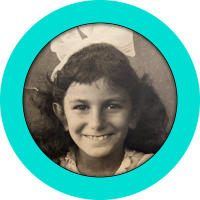
Barbara Bandler Steinmetz
Transcript
Barbara: I was in Hungary for one month. I was born in Hungary, and my parents lived in Italy. But that is the country of our families-- where our family has been living for probably well over 100 years before I was born.
Interviewer: Was there a Jewish identity in your family while they lived in Hungary?
Barbara: My parents were both from Orthodox Jewish families. My father-- my grandfather studied the Torah all the time. And as a matter of fact, there's a family story that he didn't really do a very good job in earning a living, because he was so busy studying the Torah, and whenever anybody came into his shop, he was irritated, because he had to pick his head up from studying the Talmud.
Interviewer: What shop?
Barbara: He was some kind of a wholesaler. He really had a lot of different kinds of occupations. It seemed like they, they really had a hard time earning a living. My mother's family-- her father was the chief doctor of the county in Hungary, and she came from a very educated family.
However, they were also a religious family. At that time in Hungary, there was really no such thing as a non-religious family. She came from a very small town and used to tell us that she had to travel quite far to go to the synagogue. And she went to a wonderful, beautiful, beautiful synagogue in Győr, G- Y-O-R. But she came from a town called Győrszentmarton, which is about 25, 30 miles from Győr. And so, it was quite a trip. But they had a religious education, even though there were only a few Jewish children in the community that she lived in. There may not have even been another Jewish family. I don't really know.
Chapter 1: Before the War
Transcript
Barbara: My parents had this very large hotel, and they had clients, people that came to the resort. It is a resort island on the Adriatic, and people came from all over, mostly Germany, England, probably some from France. And so there was constantly activity in our lives when we were little children. And the hotel guests played with us and talked to us when we were little children. My parents, of course, were very busy with their hotel, and so my sister and I had a nanny, a wonderful lady from Austria. Her name was "Tetsi." And she eventually moved with us from place to place and married a Jewish man, but she was-- she was really the person that we were with. But life in a hotel for a child is really quite a wonderful place, because there are not only the guests in the hotel, but all the service people that worked at the hotel. You know, the children of the owners have a very-- have a very special place. And so we were treated that way. But I left Italy when I was very young, so that kind of life I really experienced for just a very short while.
Interviewer: Are there some special memories about your parents that you'd like to share while you were in Italy?
Barbara: I don't really have a clear memory of what my parents were like. I'm going to-- only from stories that I hear, and of course, because my sister was that much older than me, and so I-- she has told me so much about what they were like. But my father and mother were both very sophisticated Europeans. They knew fine wines, certainly fine foods, and were just very, very worldly, very knowledgeable. My dad was a wonderful hotel host, and the guests came back year after year. And so they really became friends with many of the guests. It was-- as I say, it was a wonderful resort, right on the Adriatic. The town was charming-- the small Italian village. And my parents were, were just these hotel hosts and did the kinds of things that hotel hosts do. I don't remember anything more specific about my relationship with them. I'm-- I was less than three years old when I left there. So those memories I don't have.
Chapter 2: Hotel Alhambra
Transcript
Barbara: My father was a man who was extremely excited by challenges in life. And so in some respects, what happened to him met the kind of personality he was, that he was totally challenged by, by all the hurdles that he had to overcome. I'm sure that the only thing that he had in mind was to keep us alive. In that respect, he chose guests who were living in-- who had come to our hotel and asked them for help in getting out of Italy, getting out of Europe-- well, not necessarily out of Europe, but certainly getting out of Italy at the time.
And with that, he wrote or he asked for a letter of good conduct, which was sent to embassies around. And I'd like to read the letter of good conduct right now that came in 1938. This was one of the ones that was sent to the British consulate. And it's from the mayor of the municipality of Lussinpiccolo. And it says that Mr. Alex-- Mr. Samuel Bandler is keeping a great hotel at Cigale, municipality of Lussinpiccolo, since the year 1927, and that during these 12 years of residence in this city, he had an irreproachable conduct, both from the political and moral point of view. In his quality of hotel keeper, Mr. Bandler cooperated to the increase of the industry of foreigners with praiseworthy zeal. And this is from the town hall of Lussinpiccolo, September 12, 1938. And this letter was sent around.
Chapter 2: Hotel Alhambra
Transcript
Barbara: I was in Italy approximately three years. We left Italy. We were still in Trieste in 1939. September 1, 1938, there was-- Mussolini had to comply with Hitler's demand to rid Italy of its Jews. And so there was a proclamation that went out that all Jews that were not born in Italy after-- that were born in Italy-- I'm sorry-- that were not born in Italy before 1900 had to leave the country. And so my parents had to dispose of the hotel and, and leave the country.
We-- my father really was very knowledgeable about what was going on in Europe, partly because there were so many guests there. He was always very interested in politics, and he was-- he was very up to date with what was happening in the world. And since the Nuremberg laws and since all of-- and since Kristallnacht, he had a premonition of what was happening in Europe and what was going to happen. And so he started looking for other places for his family to go before we were actually-- before we actually left Italy. And so he started writing letters. He started inquiring from guests that came from other countries whether we would be able to get entry into their countries. And so, so when we left Italy, it was, it was not only not a surprise for my dad, but he was trying to already make arrangements for us to go elsewhere. The problem, of course, in Europe was, where do you go? But we had to-- we had to leave Italy. We had to pack all of our belongings and leave them in warehouses-- in a warehouse in Trieste, because, of course, we were only able to travel with just the things that we could carry easily.
Chapter 3: Antisemitism on the Rise
Transcript
Barbara: So we left Italy about 19-- well, in 1939, the beginning of 1939. In March or April of 1939, we were still in Trieste. But that fall, that summer and fall, we went back to Hungary after we left Italy. We spent-- my sister, my mother, and I spent the summer in Hungary with our family, saying goodbye, and I think trying to figure out what we were going to do next. My father was trying to convince members of his family that it was time for everyone to leave, that 1938, '39, things were really imminent. Poland had been invaded. Things did not look good for the Jews. But Hungarian Jews had lived very comfortably in Hungary for a very long time, and they felt very comfortable with their non-Jewish neighbors. And they couldn't believe that in a country where they were relatively accepted and free, that, that they were threatened. And so both my parents come from rather sizable families, particularly my father. His-- he was-- his mother came from a family of 14, so there were lots of aunts and uncles and cousins all over. And so I think they spent that summer trying to convince people to leave, to no avail.
People seemed to, to feel that he was over-alarmed about what was going to happen. They, after all, had their homes. They had their belongings. They had their lace and their velvet and their clothes and their belongings, and they were very attached to their belongings. And they-- unless the threat was really imminent, they really didn't want to leave them. My father really had a very different view of things, and it was something that was imbued in us for all the years that he was alive-- that things were not important. It was people that were important. It was what you have in your brain and in your heart, that that was the only thing that was really important. And that's totally transportable. And it was something that was constantly talked about, because my parents left Italy, and it, seemingly, from our point of view, it seemed like they left it easily. I'm sure that it must have been very painful for them.
Chapter 3: Antisemitism on the Rise
Transcript
Barbara: When we lived in Nice, my mother and father both worked. I think my mother worked in some kind of a Jewish agency kitchen. Now one of the things that you might want to know about my mother is that she was an extremely educated woman. When she was a young girl, she was 17 when she graduated from a high school. And she went to the university, which was unusual in 1917 for a Jewish European woman to go away to school. She had her own apartment. And she received a degree in chemistry. She was a chemist and a pharmacologist. And before she was married to my father, she worked as a pharmacologist. And so she-- she was a professional woman. And here she was now in Nice. And she was working in the kitchen, cooking. She had an unfortunate experience. A pot of boiling water fell on her. And she had severe third-degree burns all over her legs. And she was hospitalized for a long period of time.
My father tried to take care of us. We were very young. And we were frequently left alone because both my father and my mother worked. And Tetsi, who was our nanny, although she also came to Nice, she also had to go to work. I mean, there was -- there was no money. We had no money to take with us. So everyone had to work. And my sister and I were frequently left alone.
During those times, it was very frightening because this was the beginning of the invasion from Italy. And there were daily air raids over Nice. And my sister and I would hear the airplanes. And we wouldn't know what to do. And we were frightened.
So we went and sat under the table, because it seemed like we remembered that our parents said you always have to get underneath something when you hear an air raid. And so we went under the table. And frequently when my father would come home, that's where he would find us, is under the table.
Chapter 3: Antisemitism on the Rise
Transcript
Barbara: And Trujillo had previous experience with Jews because he had from Curacao. So he knew that Jews, when you invite Jews into a country, that they are participators, that they will help with the economy of the country. And so he had a lot of reasons for opening his doors. But regardless, he did open them. Unfortunately, it took a long time to set up the bureaucratic mechanism by which the Jews could actually leave Europe and get to the Dominican Republic. For that purpose, an organization was set up by the Joint Distribution Committee of the Jewish Welfare Federation and of UJA. And-- and they a-- they had an agricultural division. And they went to the Dominican Republic. By the time they looked over the prospects for the land and made their recommendations as to how this was all going to happen, it took a long time, frankly. And it wasn't until 1940 that an actual agreement was--was signed by the parties of the Dominican Republic and the Joint Distribution Committee, the agricultural division. And for that purpose, a-- an organization was set up specifically for the Dominican Republic, and it was called the Dominican Republic Resettlement Association [sic]. And the acronym is DORSA. And they found someone to be the head of DORSA. It was a man who had a great deal of agricultural experience, immigrant experience, in the Crimea. And his name was Rosen. And he had an idea that he was going to set up a kibbutz-type operation in the Dominican Republic.
Now the piece of land that was given to the Jews by Trujillo--and-- and there's a-- there were a lot of negotiations about it-- was a rather rocky, [PAUSES FOR 3 SECONDS] untillable kind of land. It was-- it was in the tropics. It-- it was-- it was a very hard piece of property to farm. But nevertheless, this was the property that was given to the Jews. And so they were going to do something with it. But Mr. Rosen really thought that-- that he would set up a-- a kibbutz-type of situation. And so what he was looking for was Jews that had agricultural experience. And that immediately eliminated most of the Jews that were left in Lisbon because they were not the farmers. They were the doctors and the lawyers and the-- and the business people and the accountants. And frankly, they didn't know one end of a shovel from the other. But-- but my father obviously applied for entry into the Dominican Republic. And he said of course he had agricultural experience. He was a food handler. And of course, he may not have told them that. But he did tell them that they had agricultural experience. And my mother, who was a chemist, her-- her area of specialty was casein, which is a milk product. And so they seemed like they were going to be very likely candidates. And somehow or other, they-- they did get a visa to go to the Dominican Republic. And—
Interviewer: Did your parents tell you that you were going to be going?
Barbara: You know, I don't even know that. I don't even know that. I know this much, that the Jews that did go had absolutely no idea what to anticipate when they went to the Dominican Republic. First of all, these were European Jews coming out of a temperate climate. The Dominican Republic is in the tropics. So they just-- I think they would have signed on to go to the moon. They just wanted to get out of Europe. And the Dominican Republic also was fairly close to the United States. So there seemed to be a glimmer of hope somewhere down the road that they would get to America.
Chapter 5: Evian Conference and Hispaniola
Transcript
Barbara: We left in May of 1941. And we went on a boat-- on a ship called the Nyassa, N-Y-A-S-S-A. And that ship was the last ship that left the European continent, May of 1941. And that is a matter of record. It was the last ship. And we went in steerage.
Now the-- the trip was paid for by the Joint Distribution Committee. But-- because of course, the Jews that left Europe didn't have very much to-- very much money to take with them. And so the passage was a loan from the Joint Distribution Committee, which was to be paid back through work at a later date.
But I do remember going on the ship. And the ship was headed for New York, for Ellis Island. And all the passengers on the boat, as I said, we were in steerage. So we were-- we slept in large dormitories at the bottom of the boat. And I'm going to-- I-- I think that the boat was probably filled to the brim with anybody and everybody that just wanted to get out of the continent. So we landed in Ellis Island. I don't-- I don't know how long we were on the ship, whether it was a week or whatever.
Interviewer: What were the conditions like on the ship?
Barbara: I don't remember. I don't remember. I'm-- I'm going to guess that they were probably pretty crowded wherever-- wherever you went on-- on shipboard. I remember being-- being out on deck. But that's all I remember. But I do remember Ellis Island. We got to Ellis Island. And I'm not sure how long we were there. It might have been-- it might have been as long as two weeks. Everyone was herded into the large room in Ellis Island. It was confusing. It was noisy. What I do remember about Ellis Island is the smell. It-- there were these very strange, strange smells. And-- and that's pretty much what I remember when I initially got to Ellis Island.
When we were there, the families were separated. And this was really about the first time that my family was separated. My-- my mother slept in a dormitory of women with-- with the two of us, with my sister and myself. And my father slept in the men's dormitory. And the only time we were able to see my father was at meal times. And-- and I'm-- I can't even remember whether I actually saw him in the playground. There was a playground. And we were allowed to go out into the open for about an hour or two a day. The rest of the time, we were inside the building. And that's mostly what I remember about Ellis Island, was the playground. It must have been just wonderful for a kid to be able to get out and breathe some fresh air, because the conditions inside in Ellis Island were very crowded. And when I say that I remember the smell, it-- it must have been just a lot of stale air because there were so many people. And they were all crowded together.
Chapter 6: A brush with Ellis Island
Transcript
Barbara: While we were in Ellis Island, my father made contact with relatives. My father had a brother that lived here in the United States, a brother that came here in the mid '30s. And-- and he was a waiter. He had a very hard time earning a living. And frankly, he had very little. My mother also had a relative here. And her-- I think it was either her second or third cousin, some distant relative, obviously somebody that had been in this country for many, many years. And it was just a name she had. And they contacted their relatives. And my Uncle Eugene came to Ellis Island to see us. And the family's name was Gold. They lived in Jamaica-- my mother's family's name was Gold. They lived in Jamaica Plain. And they were-- they owned a cemetery. And they had a funeral business.
And all we knew about them was that they were-- that their name matched their wealth. They were exceedingly wealthy people. My mother did not know them personally. But they came to Ellis Island to visit us. And they brought each of us a doll. I mean, that-- that was the sum total of what I remembered about them until many years later. But they did bring us a doll. Now, you have to know that my sister and I did not bring any toys with us. When we left Italy, we left everything behind. And I don't know how-- how I even felt about that. And I-- you know, I don't remember how I felt about that. And it probably is something that, as a young child, I suppressed. But everything that I owned that was dear to me as a little girl, I had to leave behind. And I probably had things in Hungary too when we went to visit but had to leave that behind. And I'm going to guess that we might have also had some things in Nice. But by the time we got to Ellis Island, we did not have anything at all. And so these dolls became the most important thing in the world to us.
Interviewer: Do you remember the doll's name?
Barbara: No, I don't remember the doll's name. But I do remember what happened to it in the Dominican Republic. Cockroaches! [Laughing] ate-- ate around its eyes. And it didn't bother me at all. I loved that doll. and for-- it seems like I still have the doll somewhere. And I've been trying to find it. And I-- it's probably hidden somewhere in the basement. But I kept the doll all the years, and even with its deformed eyes.
Chapter 6: A brush with Ellis Island
Transcript
Barbara: Now Sosúa, in-- Sosúa was actually started in 1940-- the December or-- December of 1940. And so it was-- it was a relatively new settlement, and it was a piece of property that had once been farmed by the United Fruit Company. They tried to grow bananas there. They couldn't. The soil was not very good for agriculture, but nevertheless, this was going to be the settlement. There were some buildings that were left over from the United Fruit days, and that was-- those were in the late '20s, early '30s, so they were relatively old buildings. Puerto Plata, at the time that we arrived, was more than what you would imagine a third-world country to be. It was a very primitive part of the world, extremely primitive, and very sparsely populated. Sosúa, which is a town about 10 miles east of Puerto Plata, was just a piece of land with a few buildings on it left over from the United Fruit Company days. And what was going to happen is there was an agreement between all the settlers and the DORSA, which was the Dominican Republic Resettlement Association, and the Dominican government to farm this land. And they-- we were actually going to homestead so that we were given a plot of land, and we were to build a building. There weren't any houses. There were just buildings, and people were just put into the buildings. But that's what the plan was-- that everybody was to build a house. They'd have a piece of land, and there was going to be a financial exchange. I mean, you-- everyone was going to be paid a certain amount of money for the work, but then all of this money had to be paid back to the-- the Joint, to the DORSA.
And [PAUSES FOR 3 SECONDS] so what-- what happened when they got there, they immediately had to start working. All of these professional people had to become builders, because they had to build their buildings. They had to become farmers. They had to try and grow their crops. They-- there was no grocery store where you can go and buy groceries. But they were given a cow and a horse, so they had to learn to milk the cows, and-- and it was-- it was summertime when we got there in-- at the end of June. And it was the rainy season, so there was mud, and it was hot. You can't believe how hot it is. I mean, the tropics are really hot, and there were bugs and mosquitoes and tarantulas. And these were-- [LAUGHS] these were Europeans that were totally unaccustomed to that kind of a life and that kind of a world. And-- and my parents built a house, and-- and I will show you the picture of the house later. And we lived in this little community, and lo and behold, it is amazing how these bunch of Jews, coming from Europe, did somehow or other make a settlement. They did milk their cows, and they-- and they cooked. We had-- we had a-- a a joint kitchen. All the women took their turns cooking for everyone. We had a joint dining hall. Everyone ate together. The houses did not have individual kitchens. It was really a communal-- communal living.
And-- and they farmed. Their-- their crops were not successful. As a matter of fact, they were very unsuccessful. They tried growing tomatoes. The tomato crop-- crop failed. They were-- they were digging. When it rained, there was mud that was way up to the top of their boots. And these men, who were just not used to working in this-- in this soil that was sandy-- it was full shells. It was craggy and rocky, and they worked very, very hard. And not only did they work very hard in that unbelievable heat, but people got diseases.
Chapter 7: Life in Sosúa
Transcript
Barbara: As I said, there was-- there were a lot of people that were severely ill and became severely ill. And I'm just trying to remember a couple of experiences in Sosua, and one of them was our bathrooming experience, because, of course, we had outhouses. And we were told that we were never-- the children were told that we were never to go to the bathroom by ourselves, because there were tarantulas around. And-- but you know kids. Kids will do anything. And I remember going to the bathroom and seeing a huge tarantula and screaming and hollering, and they came, and they shot the tarantula. But it was-- and every night, when we went to sleep, we slept under mosquito netting. And-- but every night, before you went to sleep, you had to undo your bed to make sure that there weren't any tarantulas under your sheets or any other kinds of bugs, because that's where they would go hide. They would go hide under, you know, kind of dampish, dark places. So we had to make sure that we-- that we cleared all the area of-- of any of these insects.
Chapter 7: Life in Sosúa
Transcript
Barbara: They [the settlers] had dysentery, and they had terrible bad bite-- bites from the-- from the animals, from the-- from the mosquitoes and the flying critters. And-- and they-- and they got malaria and heart disease. And my mother became severely heart diseased. And the doctor told her that if she didn't get out of this climate, that she would not make it. And so my parents, once again, had to do something that was very creative. They made an agreement with the DORSA, the-- the resettlement association-- Dominican Republic Resettlement Association-- to open up an R&R place, a little hotel way up in the mountains. It just so happens that-- that the Dominican Republic has the highest mountain in the West Indies. It's not that high, but it certainly was not at sea level, as was Sosúa.
Chapter 8: Jarabacoa: Mountain refuge
Transcript
Barbara: We had to help [in the hotel]. And every day, one of my jobs was to go down to the river. And the hotel was up on a hill, and I had to go down to the river with a Dominican boy and two donkeys and with cans of water on both sides of the donkeys, and my job was to go down to the river every day and get water and bring it back up there. Our house also had a cistern, and at the time, it looked like an enormous cistern. And-- so we got some of our water from the cistern.
Our home was exceedingly primitive. It did have a floor, and-- and there were-- there were several rooms. It was a small hotel, and we had several rooms for the guests. And one of the things that we had to do was, you know, as I said, help make beds and sweep the floor, take care of the animals, because the only mode of transportation was horses. We didn't have any other way to get around, so we all had our own horses. And we had to help with the-- with the cows. We had to help with the milking, because that's what provided us with cheese. My mother made the cheese, and I can remember, she had a clothesline hanging, and I can remember the cheese and the-- the milk product in the cloth, and all day long, it dripped down on-- on the mud floor with big drips of milk going all over the place.
We had chickens, which we slaughtered ourselves, because that's-- that's how we got food. And so we had cattle, and we had our chickens, and we purchased some crops, although we had a finca, we had a farm on which the Dominicans worked and raised some crops for us to use in cooking. And eventually, we acquired two other houses that were adjacent to our first house. And they were also for guests, so as time passed by, we had more and more guests coming. And-- and it was a very interesting life for a kid. We spent our days horseback riding, working, and playing with the Dominican children, running around barefoot, and having what, at the time, seemed like-- and it was! It was a wonderful life. It was a life of peace.
Chapter 8: Jarabacoa: Mountain refuge
Transcript
Barbara: As you-- as you know, schooling is terribly important. And since we were living in this isolated part of the world, my parents had to find an appropriate school. And what they found was something that was-- the closest thing was a school in a town called La Vega, which I'm going to guess is about 25, 30, 40 miles from Jarabacoa, down the mountain.
And it is a--a school run by Catholic nuns, nuns from Spain. And so my father wrote to them inquiring as to whether their daughters, his daughters, could go to that school. And the response from the Mother Superior was that yes, we could come to the school. However, there were some stipulations. We had to go to church every day. We had to go to catechism every week. We did not have to take communion, and we did not have to be baptized, and that no one was to know that we were Jewish because it was not--it was not going to be a good thing for us, but that she wanted us to go to church every day because she did not want the taunts of-- she didn't want the other children to taunt us. And she didn't want us to stand out from the other children. She didn't think that that was a good thing.
Interviewer: How many Jewish children in the school?
Barbara: We were it. My sister and I, we were the Jewish kids. And so September of 1942, my sister and I and my mom got on horseback, because that was our only means of transportation, with our few belongings. And we went by horse to-- up to the school. Now I have to tell you that-- that this was probably the first time I had ever seen nuns in full habit. And that was a rather frightening experience for a not quite five-year-old. And-- and so I was--was very frightened by the experience. Also, it was very austere-looking. All the children were in uniforms. And it was a boarding school, obviously. My parents were going to leave us at that school. Now one-- one of the things that had always been, my parents were always, always with us through all of our trips, from Italy, to Hungary, to Nice, to Lisbon, to Ellis Island, to Sosua. There was one thing that was permanent in my 4 and 1/2 years of existence, and that was having my mother and father. And even though the world around me might have been crashing, and maybe every year I was in a country that had a different language, but my parents were always there. And they were leaving us now in a foreign country with a foreign language with people that looked really, really different. We didn't know a soul, and it was terribly, terribly traumatic.
Chapter 9: A Catholic education
Transcript
Barbara: The school was-- was really a very wonderful school. The nuns were warm, loving, caring, well-educated. My sister and I had a wonderful, wonderful education at the school. It--we played great games in the school. There was a-- there was a wonderful statue of the Virgin Mary in the courtyard. And that's where we played tag, and the Virgin Mary was it. I mean, that we had to touch it in order-- and then we--we would hide under the benches. And there was a grotto at the-- when you first walked into the school, there was a beautiful, beautiful grotto. And I would stand at the grotto because it was just covered with-- with greens and candles, and it was-- it was just wonderful and beautiful.
And I learned to love going to church every morning. There is-- there is a mystique about the Catholic church, and particularly the Catholic church in Latin American countries because it's-- it's practiced in the old way. There is-- the-- the priest comes in with his very fancy clothes and followed by altar boys with incense, and the church gets filled with incense. And to a young child that was pushed from hither and yon, it-- it represented stability. And I-- I remember loving the smell of the incense in the church. And I loved-- I loved the-- the regularity of life. I loved knowing what I had to do every day and who was going to be there. There was a permanence. We- -we rarely went out of the school. The school-- we slept at the school. We ate at the school. We-- we, obviously, we went to school. I had piano lessons in the school. We played in the yard. And everything was within the gates of the school. There were-- there was like a high fence around the entire property, which totally separated it from the rest of the world. And it was-- it was like being in a haven. And for three years we went to school in this haven. And it-- it provided a stability that I had never known before. And I loved it.
[...]
Interviewer: During this time, did you have any Jewish identity?
Barbara: I knew that I was Jewish. I never said anything to anyone about it.
Chapter 9: A Catholic education
Transcript
Barbara: We-- we stayed in-- in the Dominican Republic until 1945. I mean, a number of things happened while we were there for my parents. First of all, my mother, as I said to you, was a chemist. And she had done work with casein, with milk products. And she had formulas for perfumes. And she was in contact with the Dominican government because they were going to set up a company and help her go into business. She had told them that this was-- that this would be a very good thing for the economy of the country. Somehow or other, and I don't know why, it just didn't work out. So she never did start the-- the perfume industry, or perfume business. I still have her booklet full of chemical formulas. But because of that, she needed some chemicals. She needed some additional materials. And so she wrote to a Jewish newspaper in the United States in the Boston area, or Boston-- probably New York. I don't remember just where. And she put an ad in asking for chemistry books because she needed to, I don't know, work out the formula. Somehow or other she needed to do something with-- with her chemistry.
At that time, there was a woman living in Boston who was an old, old girlhood friend of my father's and mother's. And as a matter of fact, she had dated my father as a young woman. And she was wrapping packages for Europe. She had come-- she and her husband and son-- her name was Elenor Mayer. Her husband's name was Eugene Mayer, and their son George. They had come to the United States sometime in the mid-'30s. And their life was very difficult in Boston. They lived in a little garret apartment, and she-- she was a seamstress, and she worked in a-- I don't know-- a bra factory, something like that. Anyhow, she was wrapping packages to send to Europe, and a name caught her eye, and the name Bandler. And she read the ad, and she immediately contacted my parents. And I don't know what year this was. I don't know whether it was 42 or '43. You know, I don't know. But I know that my parents obviously asked her what she could do to help us come to the United States.
As far as my parents were concerned, and probably most of the people that went to Sosua, that sought a haven in the Dominican Republic, that no sooner did they get there that they knew that their life, way into the future, was not going to be in the Dominican Republic. That if-- if the war was over, when the war was over, that somehow or other they were going to make their way back. You know, this was, as I said, a very primitive land. And this was not where these Europeans saw themselves for the rest of their days, my father included. Not only that, but in Jarabacoa, there was not going to be a Jewish life for his children, and really a Jewish education. The education that they were-- that we were receiving was OK for now. But obviously my parents were not in this place for the long haul. So they immediately asked her to start working toward getting us into the United States.
My uncle Eugene, who we saw when we were in Ellis Island, he was unable to help us because he-- he was a waiter. He was-- he was living in a-- in a rented, furnished room. He was not-- he didn't have any contacts. He had a hard time with the language. He was not in any position to really help us. My mother's cousin, who also-- who gave us the dolls on Ellis Island, they were unwilling to help us.
And so Elenor Mayer, since she was our first contact-- and she-- she was a terrific lady. And although they didn't have the funds or the know-how as to how to get us to this country, she knew someone that did. She attended a synagogue in Roxbury, Boston, Massachusetts. And the cantor there was a man called Cantor Glickstein. And he was-- not only was he a chazzan, but he was-- he was like the leader in the Hungarian Jewish community. And he was-- he was like a tzadik. He was a great man. He was a wonderful, warm, loving person. And she implored to him to see what he could do to get us to this country. And so we started. My father started once again, you know, with the letters of reference, you know, as to who we are and what we do, and that my mother is a chemist, and that he is a--and a pharmacologist-- and that he is a-- a-- a hotel owner, and that he would be able to run a hotel, and that he would not be a burden to anyone in this country, that he would come here. And he would be an exemplary-- that we would be exemplary citizens worthy of coming to the United States.
Chapter 10: Letter from Boston
Transcript
Barbara: And in 1945, we got a visa that-- and it said that we-- we were-- we were accepted. We were eligible to come to this country [the United States].
Interviewer: How was your journey?
Barbara: I remember my-- my sister and I didn't know any of this. I mean, all we knew-- we knew that summer vacation was coming. And this was in the spring of 1945. Summer vacation was coming, and that we were going to go back to Jarabacoa and have a life with our horses and-- and the people that we like there, and the guests from Sosua. And you know, one thing I do want to say, that one thing my parents had in Jarabacoa is a radio. That was the only contact. I mean, they were-- I mean, it's really far from civilization, I mean really far. But they-- they did have radio contact, so they knew what was going in the outside world, and I'm sure were very alert to what was going on.
But anyway, my sister and I, I don't think we knew that we were leaving. My parents-- from my recollection, my parents came by horseback to the school and fetched us, and that we then took a bus from the school to Ciudad Trujillo, which is the capital city in the southern part of the island. And from there we caught an airplane. And how-- what kind of arrangements, who made the arrangements, who paid for it, I have no idea. I'm going to guess that Cantor Glickstein [from the Mayer's synagogue] got some money together and-- and paid for our fare.
And with that, on June 1, 1945, we left the Dominican Republic-- frankly, the only stability that I remembered in my short life-- and we left. And we came to America. We landed in Miami, didn't know a word of English. We were met there by my Uncle Eugene, who was living in Miami. And we stayed in Miami-- in Miami for about two weeks. I remember we stayed in a hotel called the Neron Hotel across the street from the ocean, around 1st, 2nd Avenue in Miami. And it was a wonderful two weeks because we played, and we swam in the ocean. And-- and I don't know-- as a kid, I don't know what was up ahead for us. But because our sponsors were from Boston, it stood to reason that we would go to Boston.
Chapter 11: Boston: New challenges
Transcript
Barbara: And it was my parents' first experience with social workers because from there, the Jewish Welfare Federation took ahold of us. I mean, that's-- that's who managed our lives the first few years that we were here in this country, is the Jewish Welfare Federation. The-- one of the-- well, one of the things that the Jewish Welfare wanted to do was-- I mean had to do-- was to find employment for my parents. And when my parents were employed-- because we came here in June 1, so by the middle of June we were in Boston. There was no school. We had no place to live. My parents got jobs at a-- at a resort called Bretton Woods. And-- but the proviso was that they did not bring their children. And so the social workers who greeted my parents in Boston told my parents that we had to be-- we had to go to foster homes. And my mother hit the ceiling. She said she did not bring her family and schlep them from all parts of Europe to the Dominican Republic to the haven of the United States to send her children to a foster home. And she would hear none of it. And so-- I mean, that was my mother's first experience with social workers. From that day on, boy, you mentioned social workers to my mother, [LAUGHS] she was not very happy with them. She just thought it was the wrong decision for them to make.
But anyway, we did have to-- - they did have to find a place for us. And what they did, they found a summer camp for us up in New Hampshire called Camp Eden. And when my parents went to work in Bretton Woods, my sister and I were put on a train to Camp Eden, which was in the woods of New Hampshire. And it was the second most traumatic experience of our lives because my sister and I landed there. We did not know one word of English. No one knew Spanish. We didn't know a soul, and we were separated from our parents. And my sister and I stood there on the platform, and we just-- we sobbed and we sobbed for-- well, it was days before anybody could just pull us apart from one another. We just-- it was singularly such a frightening experience to be there with all these strangers.
Interviewer: How old were you at that time?
Barbara: I was 8 and 1/2. Yeah. 8 and 1/2, almost nine.
Chapter 11: Boston: New challenges
Transcript
Barbara: ...in September, when we went to live in Boston, my sister and I started school. I started the fourth grade. My sister must have started the eighth grade. I'm gonna guess. I can't remember. But anyway, I started the fourth grade.
My parents went to work. My mother worked in a chocolate factory-- Schrafft's. And she had a very difficult time, because not only didn't she speak English-- maybe by that time she-- she knew a few words-- but her co-workers called her a greenhorn and had all kinds of negative things to say to her. Refugees were not looked at kindly. Now, I don't know whether it was because they were taking employment away or whether they were threatened-- they were a threat to people. But anyway, they were not very kind to her.
My father went to work as a chef. Now, my dad knew a lot about hotels, but he didn't know much about actually doing the cooking, because my mother, in the Dominican Republic, did all the cooking. But now this was the only kind of work that he was able to get. And so he was fired from one place after another. He would-- he would get hired. He would say that he was a chef from the continent. And they would hire him. And he and my mother would look through recipes at night. And while he was at work during the daytime, he would look at what other chefs were doing, and he would try and copy them. And then they'd fire him. So he had multiple jobs that first year.
And as I say, his use of the language was very bad. Her use of the language was bad. And-- and they-- they had a very difficult time. We lived in one room in a little furnished apartment in Back Bay, Boston. And everything-- all the clothing that we had-- everything came from the Jewish welfare. We-- nothing was our own. And after several months, my parents accumulated enough money that my father came home one night with a brand new radio. And you would think that it was the greatest thing in the whole world. We were so excited about this radio. But it-- life was difficult. Somehow or other we made it through that first year in Boston. It was a horrible, cold winter. [PAUSES FOR 3 SECONDS] If you recall now, we were in the Dominican Republic, where it was [LAUGHS] very hot. And all of a sudden, we were in Boston where it was miserably cold and windy and rainy. And it-- and we-- we all suffered terribly that first winter.
Chapter 11: Boston: New challenges
Transcript
Barbara: Anyway, going back to New York, we found that my cousin-- my cousin Panni and my cousin Oscar were alive and-- and my-- that they were the children of my uncle that already lived here in this country. And he was in no position to take care of them. My cousin was under 18, and she was able to come to this country right after the war. But she had no place to go. So she came to live with us. We lived in this tiny, little furnished place. And my cousin came to live with us. The-- she had suffered a great deal during the war. She'd lost her mother.
Her brother wasn't around. Her father wasn't around. She kind of was pushed from place to place. She really-- she suffered a great deal. When she came to live with us, she had nothing. She had not-- she had not known any kind of safe harbor for the-- for many years. Her birthday's on November 6, and she came to live with us sometime in September or October. Now November 6, my mother made a birthday cake for her, [PAUSES FOR 5 SECONDS] and went out and bought her a brand new sweater. She hadn't had anything new. [PAUSES FOR 3 SECONDS] She hadn't had anything in so many years. [PAUSES FOR 3 SECONDS] And it impacted us all. [PAUSES FOR 3 SECONDS] Anyway, she came here at 17, and she had not been at school. And of course, coming to this country, she couldn't go to school, because she had to go to work. And so she was under 17. She was under 18, and she started working. She knew how to sew, and she went to work in a bra factory. But she lived with us for many years. And she's still like an older sister to me. She's a-- a very special person. [PAUSES FOR 3 SECONDS]
In terms of our family in Hungary, when we found out who was alive, my father immediately-- my father and mother-- immediately started sending packages to Hungary. And those packages kept them alive. Because after the war, they had nothing. And so my parents, with the little money that they earned-- remember, we were living in a furnished apartment with all of our clothing from the welfare federation. But my parents took all the money that they had, and they bought cocoa. And they bought coffee. And they bought nylons-- anything that the family in Europe could sell-- not to use themselves, but to sell-- and use the money for whatever. And I can remember being-- I don't know, maybe nine, 10, 11 years old at the time-- those years-- saying to my parents that I wanted new clothes like the other girls in school. I mean, I looked like a refugee. And-- [PAUSES FOR 3 SECONDS] and my father said that, you know, that taking care of our family was the most important thing.
Chapter 12: Old dreams, new Lessons
Transcript
Barbara: Sometime during the year-- well, that-- the fall of the year that we moved to New York was the end of the war-- was--and-- and my-- we heard about our family in Europe. And we heard that, well, actually, it was the-- I'm sorry. I-- I have to go back. It was when we were living in Boston. That was 1945. That was when we heard about our family in Europe. And the first telegram that we received was that our family in-- in Budapest, my father's brother and wife and son were alive, but that my mother's family, they didn't-- hadn't heard about anything about my mother's family. They lived in Győr. They didn't live in Budapest. We knew that the Jews from the outlying districts of Budapest were killed. They were all taken. And then we received-- the following telegram we received was that my grandmother had also died. And my-- but she died immediately after the war. She didn't die during the war. And I think she died of a brain hemorrhage. I-- I-- I can't remember. But-- but I remember my father was devastated by the news. And it was the only time I ever saw my father cry. But when he received the telegram, he-- he burst into tears. He just-- that his-- his family had been decimated. [PAUSES FOR 3 SECONDS] My mother's sister-- we subsequently learned that my mother's sister and niece and child were-- were also killed in Auschwitz.
Interviewer: What were their names?
Barbara: My mother's sister's name was Elizabeth-- Erzsebet Steiner-- Vamosi Steiner. And my cousin's name was Klari Steiner, and she-- she was married. And I can't remember what her married name was. And she had a child, and they were-- - they were killed. I think her husband was also killed.
Interviewer: Do you remember this news yourself?
Barbara: I don't remember the news. I remember my father-- I remember my father's total devastation. I'm gonna guess I-- my mother also was devastated, but it probably-- for a kid-- I was probably so impacted by my father breaking down. My father never broke down. And through all of the-- all the-- all our wanderings, he was the most determined man. He was-- he was a man that found out all the facts, and then he just pushed forward no matter what.
He didn't-- he didn't look back. He made a decision. And the decision was-- that was it. It was the best decision that he could make at the time, and he just forged forward. And you know, to see him break down, I must--for a kid, I must have been just shocked to see him break down and cry. I'd never-- I never perceived him to have any kind of softness about him. He was a tough man when it came to-- to everything-- when it came to educating us, when it came to disciplining us. He was very rigid in his disciplining. He had great expectations of his kids. We were to perform all the time. And there was no excuse for not performing. He always wanted us to function at our absolute max. And it was to preserve us. He-- I think that he knew that that's what-- that's what kept him alive--was to be a strong person and to be a determined person. And that's what he passed on to us.
Chapter 12: Old dreams, new Lessons
Transcript
Barbara: In 1950 [sic: 1990], we heard that there was going to be a reunion in Sosúa. And so my sister and I decided that this was a good time for us to go back and find out where our life was, where we had left it, and renew acquaintanceships, and just-- just to go back and pick up some pieces of that life. And so in June of 1990, we went back to the 50th reunion. There were-- there are very few Jews left in Sosúa.
[...]
They want to make sure that the world remembers that Sosúa played a very important role in saving the lives of these few hundred Jews. Unfortunately, it could have saved the lives of 100,000 Jews. But that was obviously not to be. But we owe our lives to the fact that Sosúa is. And so this museum commemorates it. During this commemoration, the--the head of the government was invited to the Shabbat service that we had. And at that time, people got up to [PAUSES FOR 3 SECONDS] speak of their gratitude to the country for opening its doors, that this small country in the Caribbean, insignificant, seemingly insignificant little country that no one had ever heard of before, did open its doors, did save these people. And there isn't a one of them that isn't enormously grateful to the-- to the government of the Dominican Republic for saving their lives.
We also went back to Jarabacoa. We went-- well, we walked-- we went around Sosúa. And the school, the Escuela de Cristóbal Colon is still functioning, still a functioning school, and mostly for Dominican children. But it is still supported by the Jewish community of Sosúa. We-- we also went back to the Catholic school where I went to school, to La Escuela de Inmaculada Concepcion. And it is-- it is still there. It's-- it's been enlarged. But it's no longer a school. It's now just a place for-- for the nuns to go. But everything that we remembered is still there. The church is still there. And the grotto is still there. There was one experience that was--that-- that I remembered so clearly when I was a child there. My mother came to visit us once. And it must have been around the time of the High Holidays. And as I said, we obviously did not celebrate the High Holidays because we lived in this remote little village. And my mother came to visit us. And she said she wanted to go into the church. And I said, why do you want to go into the church? And she said she needed-- she felt that she needed to be in a house of prayer and that it didn't really matter what house of prayer that was. And it was-- it was just something that I-- that I totally remember. And you know, it probably is another thing that attaches us to Judaism, that when you are totally isolated from your peoplehood, that it is-- it's like having your arm cut off from you. And it probably was how my parents felt up in Jarabacoa, that they were totally separated from their peoplehood. And that probably was another reason why they wanted to come to the United States, that we do have a reason and a need to be together, to have a feeling of Klal Yisrael, of being together with the people of Israel.
Chapter 13: Eyes forward
Transcript
Barbara: So in-- in New York, my father was able to get a-- a position in Detroit. So again, that summer in New York I went to summer camp. My mother went to work. My cousin went to work. And -- and we ended up in September in yet another city, and a new school, and new people. And again, we all lived in a very small, furnished apartment in-- in Detroit. And I started school in Detroit. And my mother went to work for the Jewish Community Center as a cook. And the reason that I want to mention that is because the Jews in the Jewish Center didn't believe she was Jewish. And I remember my mother coming home, and she was in total disbelief. She said she didn't understand these American Jews. [LAUGHS] What did they think? My mother didn't speak Yiddish. My parents were--in-- in Hungary, not all people spoke Yiddish as the Russian and Polish Jews. They all spoke Yiddish. But Hungarian Jews did not. So my mother didn't know Yiddish. And the Jews that she had contact with in Detroit all spoke Yiddish, and they-- they didn't-- they never knew of a Jew that didn't speak Yiddish. So they didn't-- [LAUGHS] they didn't believe that she was Jewish. They also didn't want to hear about her experiences. And-- and they called her a greenhorn. The other Jewish people called her a greenhorn.
And as a matter of fact, that's-- that's really been my mom's experience in this country-- was that she was made very much aware that she was a greenhorn, and somehow or other, not as good as anyone else. And frankly, she was more educated than most of [LAUGHS] them.
Chapter 14: Life as an American teenager
Transcript
Barbara: She [Barbara's mother] and my cousin [Panni] worked at the Jewish Center, and my father worked as a cook. And eventually, after having been kicked out of so many jobs from Boston to New York and then went to cook in Detroit, he-- he is an incredible man. He was an incredible man. He truly became a great chef. And he had jobs in Detroit at the most prestigious country clubs. He was the head chef in those country clubs.
And it-- it is an amazing thing that this guy, who really went from place to place, and somehow or other had enough gumption to learn something and learn it well, and be the best. In the middle of it all, he gave it up. He was in his-- well, in 1945 when we came to this country he was 43 years old. So in 19-- by 1950, he decided he no longer wanted to be a chef. Because again, because of the family-- and the family life is very important to my parents. My dad felt that as a chef, he was working all the holidays, all the weekends. And again, he didn't schlep his family all over the world for him not to spend any time with us. His daughters were growing up, and he wanted to spend more time with us.
So the reason I'm putting this in here is just to share with you this man's incredible determination. He put an ad--he-- he read an ad in the newspaper for salesmen in the advertising specialty industry. He didn't know a thing about the advertising specialty industry. But he answered the ad. And it was someone in New York that was hiring. And--and he-- he said he wanted to do this. They sent him a bunch of samples, and he was to go calling on customers. Now, he had no background as to what to do, how to do it, how to go out. But he read through the materials. And by golly, that guy went out, and he was a salesman. He started selling specialty advertising, and he ended up doing pretty well. But it gave him some free time. It gave him his weekends off, his vacations off. And he-- he would call customers, and he would say-- say who it is on the phone. And they'd say, well, I-- I recognize you by your accent. And my-- my father would say, what accent? I don't have an accent. And he was-- he was the most determined person in the world. He was just incredible.
And my mother went to work for Burroughs Adding Machine, in the kitchen. She always continued working in the kitchen. And then she became very heart diseased and got diabetes. And unfortunately, they both died very young. My mother-- my father was 62. My mother was 66. And so they-- they really never made it to the years where they would have gotten some pleasures out of life. But they left quite a legacy with their kids.
Chapter 14: Life as an American teenager
Transcript
Barbara: I-- as I said, I grew up. I got married. I went to the university. I think that-- I think that the-- my experiences of the war have permeated my life in a myriad of ways, probably in the way I raised my kids, feeling that education was important, that music was important, that reading was important, that being a strong individual is--is-- is a very important thing, and that family and the unity of the family is really important. In all the years while we were traveling from place to place, even though I was separated from all family in Europe, they were with us every single day. When I was a child and all the years growing up, every single night when we went to bed, we would mention the names. We would say, "God bless Aunt Berzy and Uncle Arpad and Imre and Oscar and Pearl and Oscar and--and-- and Panni and our grandparents." We would name all of the members of our family so that some of them, when they came here in 1956 after the Hungarian Revolution, even though I hadn't seen them since I was three years old, I knew them. They had been part of my everyday life all the years I was growing up, so that when my cousin Imre came and my cousin Munci came, they were-- of course I knew them. They were part of my vocabulary.
Chapter 15: Know where you came from